You’ve been consistent with your workouts. You show up, follow a plan, and push yourself regularly. Yet instead of feeling stronger and more efficient, every session still feels just as hard as it did weeks or even months ago.
This is a common frustration among regular exercisers. The truth is, consistency alone doesn’t guarantee progress. When workouts stop feeling easier over time, hidden physical and neurological factors are often the real reason.
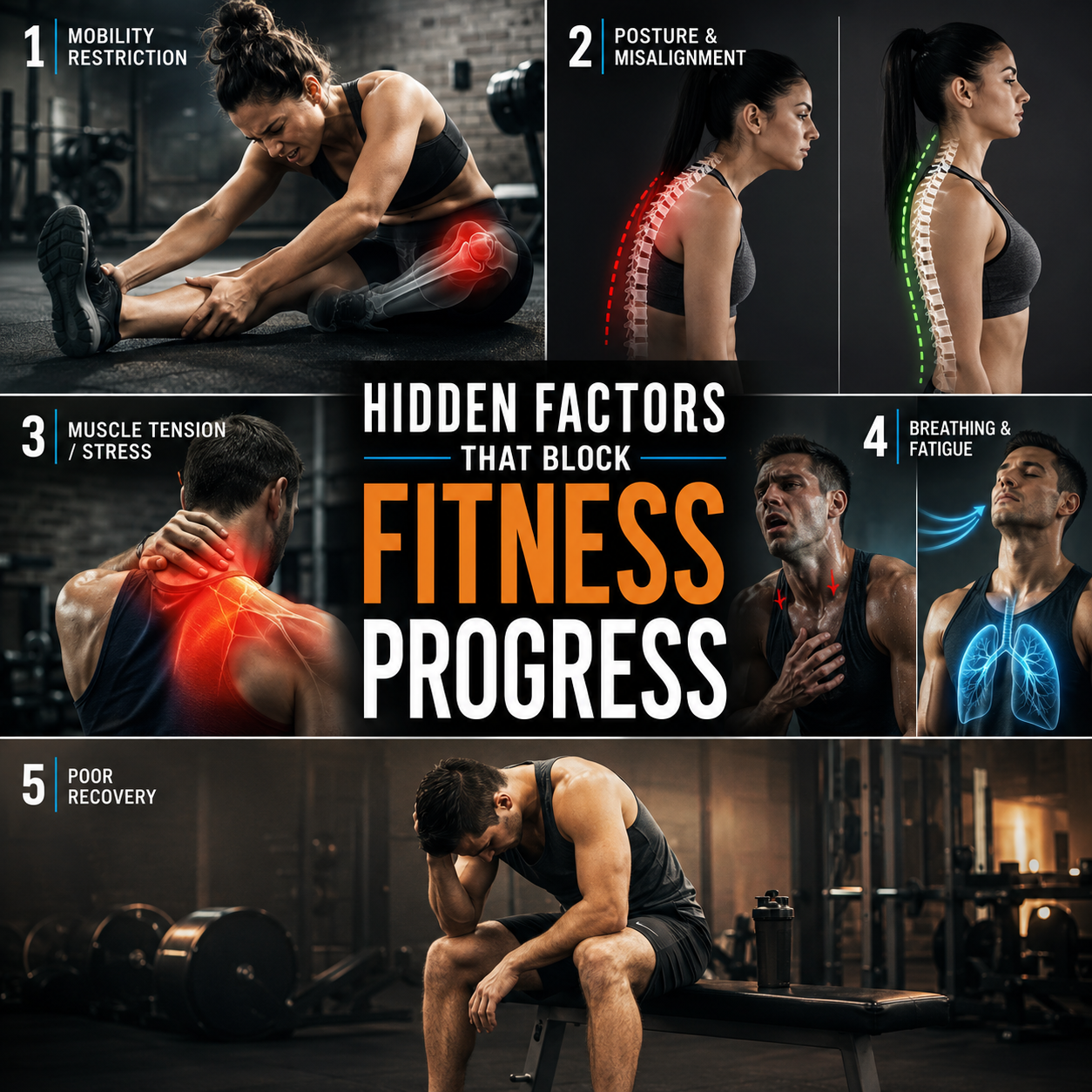
Below are five overlooked reasons your fitness progress may be stalling — and how to fix them.
1. Lack of Mobility Is Increasing Physical Strain
When joints don’t move through their full, comfortable range of motion, your body compensates. This forces muscles to work harder than necessary, making even simple exercises feel exhausting.
Poor mobility doesn’t just limit flexibility — it reduces movement efficiency. Over time, this creates uneven stress on muscles and joints, increasing fatigue and injury risk.
What to do:
Incorporate mobility work that trains control through movement, not just stretching. Focus on all three planes of motion:
- Forward/backward (sagittal)
- Side-to-side (frontal)
- Rotational (transverse)
If one side consistently feels tighter or weaker, consider working with a movement specialist or physical therapist to correct imbalances.
2. Misalignment Is Disrupting Your Movement Efficiency
Posture and alignment directly affect strength output. When your rib cage, pelvis, or spine is out of optimal position, your core can’t stabilize properly.
For example:
- Overarched lower back (anterior pelvic tilt)
- Rounded posture (posterior pelvic tilt)
- Rib flare from shallow breathing
All of these reduce force production and increase fatigue during exercise.
What to do:
Before training, reset your alignment:
- Exhale fully
- Stack ribs over pelvis
- Maintain a neutral spine
This improves stability so your muscles can generate force more efficiently instead of compensating for poor structure.
3. Protective Muscle Tension Is Working Against You
When your body senses instability, it creates protective tension. This often shows up in the neck, hips, or lower back.
While this is a natural defense mechanism, chronic tension restricts movement and increases the effort required to perform exercises.
What to do:
Stretching alone isn’t enough. You need stability first.
Try:
- Slow, controlled core work (dead bugs, bird dogs)
- Movement paired with breathing
- Exercises that promote full-body coordination
When stability improves, the nervous system allows muscles to relax naturally.
4. Inefficient Breathing Is Increasing Fatigue
Breathing has a direct impact on performance. Shallow chest breathing or frequent breath-holding increases stress on the nervous system and reduces movement efficiency.
Poor breathing patterns also force stabilizing muscles to work harder, making workouts feel more draining.
What to do:
- Use nasal breathing during warm-ups
- Exhale fully during effort phases
- Slow your pace if breathing becomes uncontrolled
- Practice deep breathing during cooldowns
Efficient breathing improves both endurance and recovery capacity.
5. Insufficient Recovery Is Blocking Adaptation
Progress doesn’t happen during workouts — it happens during recovery. Without proper rest, the body cannot repair and adapt.
Signs of poor recovery include:
- Persistent soreness
- Constant fatigue
- No improvement in performance
Over time, this can lead to overtraining symptoms and stalled progress.
What to do:
Recovery should be active, not passive:
- Prioritize sleep quality
- Manage daily stress
- Include light movement sessions (walking, yoga, mobility work)
- Fuel properly with balanced nutrition
Even one low-intensity recovery day per week can significantly improve performance.
How These Factors Work Together
These issues rarely occur in isolation.
For example:
- Poor mobility leads to misalignment
- Misalignment increases protective tension
- Tension disrupts breathing
- Poor breathing negatively affects recovery
When stacked together, these factors make workouts feel harder — even if your training plan is solid.
Fixing just one area often improves the others.
Final Takeaway
If your workouts still feel as hard as they did months ago, the issue isn’t necessarily effort — it’s efficiency.
By improving mobility, alignment, breathing, and recovery, your body can finally adapt to training the way it’s supposed to. The result is simpler movement, better performance, and more sustainable progress.
References & Trusted Sources
- Mayo Clinic – Exercise and physical conditioning guidance
https://www.mayoclinic.org - Harvard Health Publishing – Exercise, recovery, and musculoskeletal health
https://www.health.harvard.edu - National Health Service – Physical activity and injury prevention guidance
https://www.nhs.uk - Cleveland Clinic – Recovery, overtraining, and fatigue insights
https://my.clevelandclinic.org - American College of Sports Medicine – Exercise science and training principles
https://www.acsm.org - National Institute of Neurological Disorders and Stroke – Neuromuscular function and fatigue
https://www.ninds.nih.gov - Spine-health – Posture, alignment, and back pain education
https://www.spine-health.com