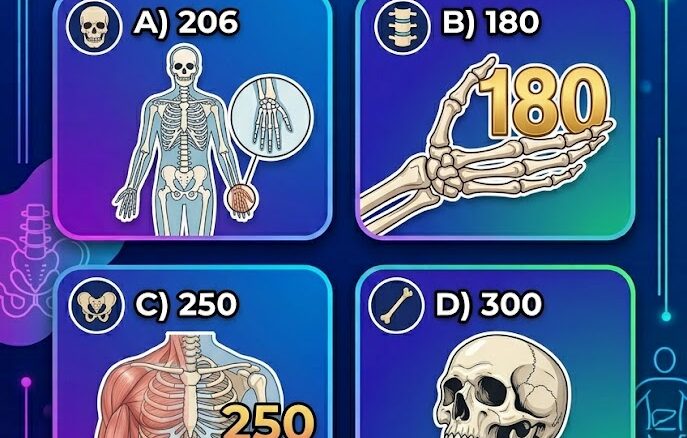
How many bones does an adult human have? It’s a question that sounds simple, but most people actually get it wrong. When you try to guess, you might think of 100, 150, or even 300—but the correct answer is very specific and often surprising.
An adult human has 206 bones in their body.
However, this number is not the same at birth. A newborn baby actually has around 270 bones. As the body grows, many of these bones gradually fuse together, forming stronger and more solid structures. This process happens mainly in the skull, spine, and pelvis, helping the body become more stable and better adapted for movement and support.
These 206 bones make up the human skeleton, which acts as the framework of the entire body. Without bones, the human body would have no structure, no protection for vital organs, and no ability to move properly.
Bones also have many important functions beyond support. They protect organs like the brain, heart, and lungs. The skull shields the brain, the rib cage protects the chest, and the spine supports the entire upper body. Bones are also responsible for producing blood cells inside the bone marrow, which is essential for life.
Another important role of bones is storing minerals like calcium and phosphorus, which the body uses for strength, energy, and repair.
So, while 206 may seem like just a number, it actually represents the foundation of your entire body. Every step you take, every movement you make, and every action you perform depends on this hidden internal structure working silently inside you every single day without you even noticing it at all.