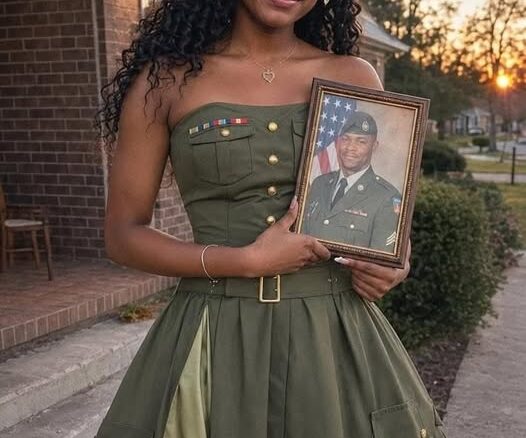
I made my prom dress from my dad’s army uniform to honor him — my stepmother mocked me until a military officer knocked on the door and handed her a note that made her turn pale.
My mom died bringing me into the world, leaving only my father and me.
Later, he remarried Camila, who had two daughters of her own.
She acted kind only when he was around. Whenever he left for duty, she became distant and cold.
But I had my father, and that was enough.
Six years ago, he died while serving.
My heart broke.
After that, Camila and her daughters showed who they really were, and I became the one who cleaned and cooked for them.
She kept saying I should be grateful she didn’t send me away.
There was nothing I could do, so I waited for college.
My father had always dreamed of seeing me at prom, so I decided to make my dress from his uniform.
I spent a month sewing it quietly.
On prom night, I walked downstairs wearing it.
Camila laughed the moment she saw me.
“You really think that looks good?”
One stepsister said, “Couldn’t your job get you something normal?”
The other added, “You look like you’re wearing scraps. That fits you.”
Tears ran down my face.
Then there was a KNOCK.
Camila opened the door, and a military officer stood there.
He said he had something for her from my father — meant for today. IT HAD BEEN MY FATHER’S FINAL REQUEST.
He handed her a NOTE.
She read it, and her hands started trembling. All THEIR LAUGHTER SUDDENLY STOPPED.I walked into the living room, the heavy fabric of my father’s old army uniform hugging my frame in a dress I had spent weeks sewing in secret. My stepmother, Camila, and her two daughters erupted into cruel laughter, their eyes scanning the repurposed patches and the faded, honorable insignia. They saw scraps; I saw the only protection I had left in this world. Then, a sharp knock echoed at the door, and the air in the room suddenly shattshattered. Standing on the porch was a high-ranking military officer, his expression grave and formal. He didn’t look at the women; he looked directly at me with a nod of profound respect. He held an official envelope, explaining that it was a delivery my father had arranged years ago, specifically for this date. He handed the document to Camila, whose smug expression vanished the moment she saw the official seal of the Department of Defense.
As she read, her face drained of color, her hands shaking so violently that the paper rattled. The silence in the room was absolute, heavy with the weight of a secret my father had kept for me. The note wasn’t just a letter; it was a legal directive. My father had anticipated exactly how his death would leave me vulnerable, and he had spent his final months ensuring I would never be a prisoner in my own home.
I stepped forward, my heart pounding against the sturdy, olive-drab fabric of my dress. I reached out and took the envelope from her limp fingers. The officer’s voice was steady and clear as he addressed me by my full name, the way my father used to when he was proud. As I unfolded the documents, the room seemed to shrink around their sudden, terrified silence. My father’s signature was everywhere—on the scholarship forms, the housing documents, and a letter detailing the trust he had established to ensure my education and independence.
He had planned my escape long before I even realized I was trapped. He had turned his uniform into my armor, not just metaphorically, but through the very resources that would now carry me far away from them. I didn’t gloat, and I didn’t need to explain. I simply thanked the officer, felt the weight of my father’s legacy in my hands, and walked toward the door.
The night air felt wider and cleaner than any room I had ever known. My dress brushed against my legs, rough and familiar, smelling faintly of starch and the man who had loved me enough to fight for me even after he was gone. For the first time, I wasn’t the quiet girl in the corner of someone else’s story. I was my father’s daughter, carrying his courage on my skin, stepping into a future he had carved out of his own absence. As I walked toward the waiting car, I realized: they could laugh at the fabric, but they would never again touch what it had made of me.